

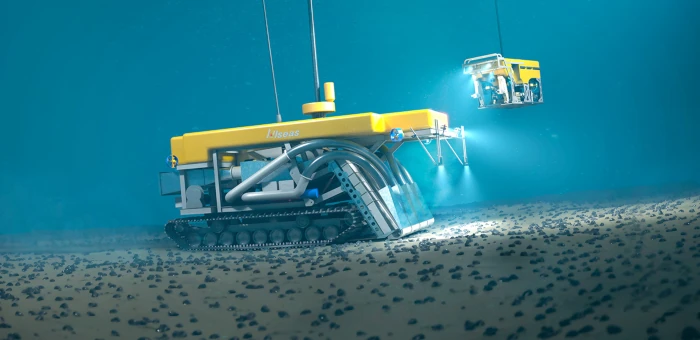
New research reveals that deep-sea mining — the extraction of minerals from the ocean floor — can cut ocean life by up to 37% in affected areas. The findings add to mounting evidence that deep-sea mining poses severe threats to marine biodiversity, ecosystem stability, and the ocean’s capacity to support global climate regulation.
What the Study Found — Dramatic Drop in Ocean Life
- According to the report, mining vehicles that disturb the seabed reduce the number of animals in those zones by 37% compared to undisturbed areas.
- The removal of the upper sediment layers — just a few centimetres deep — destroys the habitat of many macro-fauna like worms, clams, snails, sea spiders, and other small creatures. Moneycontrol
- Beyond the seabed, waste plumes released during mining can drift upward and reach the “twilight zone” (200–1,500 metres deep), starving plankton and microscopic life that underpin the entire marine food web.
- A long-term follow-up of a mining test site has shown that even decades later, biodiversity remains depressed in previously mined zones — suggesting damage may be long-lasting or permanent.
Why This Matters — Threats to Ecosystems, Climate, and Fisheries
The implications of deep-sea mining’s damage are wide-ranging and serious:
- 🐠 Biodiversity loss: Many deep-sea species are rare, slow-growing, and dependent on fragile seabed habitats. Their destruction could lead to extinctions.
- 🌊 Food-web disruption: With plankton and small marine animals harmed by mining waste, the impact can ripple up to fish, marine mammals, and ultimately humans dependent on seafood.
- 🌍 Climate impact: Deep-sea ecosystems play a vital role in carbon storage and recycling. Disturbing them may reduce the ocean’s ability to absorb carbon — undermining efforts to fight climate change.
- ⚠️ Long-term damage: The slow recovery rate of deep-sea habitats means that losses could last decades or more — making some damage effectively irreversible.
What Is Deep-Sea Mining — And Why Is It Occurring Now
Deep-sea mining targets mineral-rich seabed deposits such as “polymetallic nodules” and cobalt-rich crusts — sources of metals like nickel, manganese, cobalt and rare earths used in batteries, electronics, and green technologies.
With demand for these minerals surging due to the transition to renewable energy and electric vehicles, interest in exploiting deep-sea resources has grown — despite limited understanding of environmental consequences.
Scientific & Environmental Warnings — What Experts Urge
Because of the risks and many unknowns, scientists and environmental organisations call for a precautionary approach:
- A moratorium or delay on commercial deep-sea mining until comprehensive environmental impact studies are completed. WWF Arctic
- Strengthened international regulation to ensure seabed mining does not proceed without clear understanding of ecological, climatic, and social consequences.
- Greater investment in recycling, land-based mining alternatives, or circular economy measures — to reduce dependence on seabed minerals.
- Preservation of deep-sea biodiversity and cautious, science-led policymaking before wide-scale exploitation proceeds.
What’s Next — Questions to Watch
- Will global regulators adopt a moratorium or strict safeguards on deep-sea mining?
- Can we develop technologies that extract seabed minerals with minimal ecological damage — or is the risk too high?
- How will mining impact fisheries, carbon storage, and the ocean’s role in climate regulation over decades?
- Will ongoing and future deep-sea mining experiments follow scientific best practices, transparency, and rigorous environmental monitoring?
Conclusion
The latest evidence — showing deep-sea mining can reduce ocean life by 37% in disturbed zones — is a stark warning. As demand for minerals surges globally, the price may be paid by fragile marine ecosystems, biodiversity loss, disrupted food webs, and weakened climate resilience.
If humanity values the deep ocean — not just for its resources, but as a critical pillar of Earth’s life-support system — we must act with caution. The debate over deep-sea mining is not just about metals and profits — it’s about stewardship, ecological responsibility, and the fate of our planet’s hidden ecosystems.