

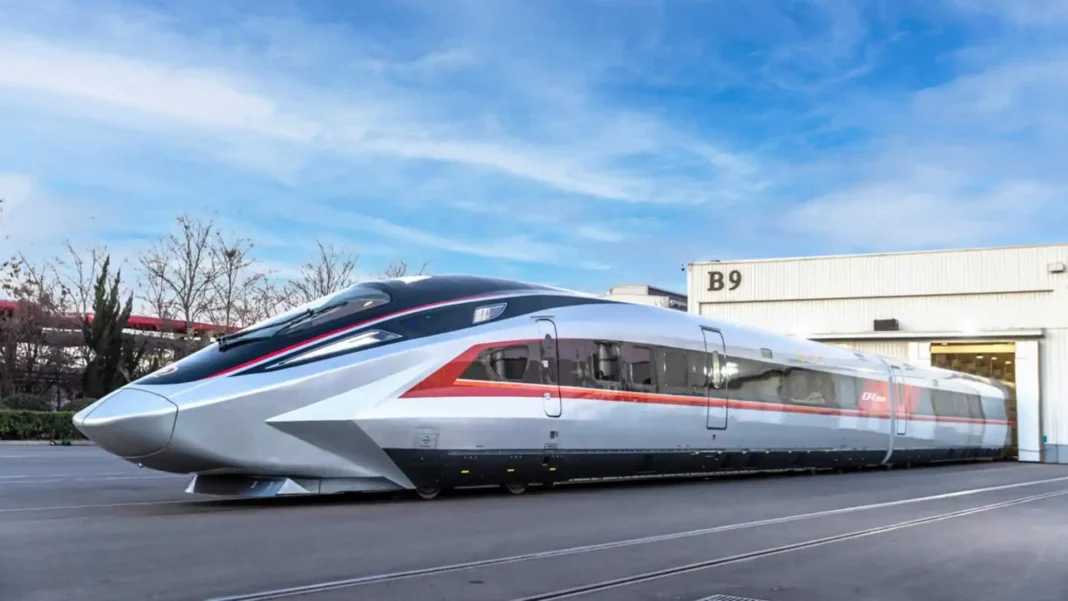
China has once again pushed the boundaries of transport technology as it achieves 700 km/h in just 2 seconds, setting a new experimental speed record. The breakthrough highlights China’s rapid progress in next-generation high-speed rail and advanced propulsion systems, reinforcing its position as a global leader in futuristic transportation research.
The achievement has drawn global attention, not only for the sheer speed involved but also for the acceleration rate, which represents a major leap in rail and magnetic levitation technology.
What the 700 km/h Speed Record Means
The moment China achieved 700 km/h in 2 seconds, it demonstrated an extreme acceleration capability that goes far beyond conventional high-speed trains. This test was conducted under controlled laboratory conditions using advanced propulsion and guidance systems, rather than on a commercial passenger route.
Reaching such speed in such a short time showcases breakthroughs in power delivery, stability control, and track or guideway design, all of which are critical for future ultra-fast transport systems.
Technology Behind the Record
The speed test is closely linked to China’s work on next-generation maglev and electromagnetic propulsion technologies. These systems reduce physical contact and friction, allowing vehicles to accelerate far more rapidly than traditional rail-based trains.
By combining advanced motors, precise control systems, and specialized testing tracks, engineers were able to safely reach 700 km/h almost instantly. This level of acceleration is considered crucial for future transport concepts such as vacuum tube transport and ultra-long-distance express travel.
China’s Long-Term Vision for Ultra-Fast Transport
China has invested heavily in transport innovation over the past two decades. From the world’s largest high-speed rail network to cutting-edge maglev projects, the country sees transportation as a strategic pillar of economic and technological growth.
This latest record fits into a broader vision where travel times between major cities could be reduced to minutes instead of hours. While commercial deployment is still years away, such tests lay the foundation for future systems that could transform logistics, commuting, and regional connectivity.
How This Compares to Existing High-Speed Trains
Today’s fastest commercial high-speed trains typically operate between 300 and 350 km/h, while existing maglev services run slightly faster under specific conditions. Achieving 700 km/h in 2 seconds places this test far beyond current passenger operations.
It is important to note that this record does not mean passengers will soon experience such acceleration. Instead, it represents a technological benchmark that helps engineers understand the limits of materials, safety systems, and human tolerance.
Global Reaction and Strategic Impact
The announcement has sparked global discussion among transport experts and policymakers. Many see the achievement as a signal that China is moving closer to dominating not just high-speed rail, but also future mobility technologies.
Other countries working on next-generation transport systems may now face increased pressure to accelerate their own research and development efforts.
Challenges Before Commercial Use
Despite the excitement, several challenges remain before such speeds can be used in real-world travel. Infrastructure costs, safety certification, passenger comfort, and energy efficiency are major hurdles. Managing extreme acceleration while ensuring human safety will be one of the most complex issues to solve.
Still, experts believe that each successful test brings ultra-fast ground transport closer to reality.