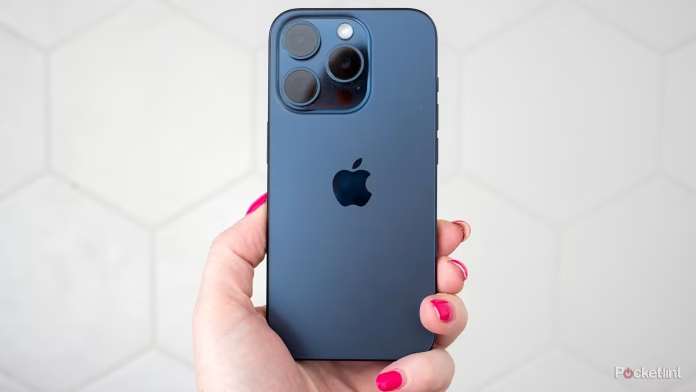


Apple is officially preparing consumers for a price hike across its hardware lineup. Outgoing CEO Tim Cook confirmed that consumer price increases have become “unavoidable” as the tech giant reaches a breaking point in absorbing soaring component expenses.
The decision marks a rare admission from Apple, which historically uses its massive supply-chain leverage to shield consumers from component inflation.
The Culprit: AI “RAMageddon”
The price hikes are not being driven by standard processor manufacturing bottlenecks, but by a severe global shortage of DRAM (volatile memory) and NAND (storage) chips.
The explosion of generative AI has created an insatiable demand from hyperscalers (like Microsoft, Google, Meta, and Amazon), who are spending roughly $700 billion collectively. Memory manufacturers like Samsung, SK Hynix, and Micron are aggressively shifting their production lines to high-value High-Bandwidth Memory (HBM) for AI data centers, leaving a drastically smaller pool of general-purpose memory for smartphones and personal computers.
Worse for Apple, these tech giants are signing aggressive 3-to-5-year prepayment contracts to lock up future memory allocations. Cook noted that this leaves consumer electronics brands fighting for dwindling supplies while memory manufacturers pass along massive price increases.
Projected Price Impact on Consumers
While Cook declined to share exact percentage hikes or name specific devices, Wall Street analysts and research groups have immediately mapped out what this means for the upcoming Fall product cycle:
- The iPhone 18 Series: Analysts at Evercore ISI suggest that the base iPhone 18 could see a baseline price increase of $100, while the premium iPhone 18 Pro and Pro Max models could face steep hikes of $150 to $270 to keep Apple’s profit margins steady. The price pain is amplified by reports that iOS 27 features will require Apple to upgrade base RAM configurations to 12GB.
- The “Configuration Squeeze”: To avoid sticker shock on base models, Apple is expected to disproportionately hike the price of higher-storage tiers (e.g., 512GB and 1TB models) or price up low-storage variants to nudge users toward higher-margin options.
- Mac and iPad Corrections: The price pressure has already leaked into the Mac ecosystem, with MacBook Air starting prices recently quietly ticking up to $1,099 (from $999) and the low-cost $599 Mac Mini model being discontinued.
Apple’s Balance Sheet Intervention
In a striking move, Cook revealed that Apple is preparing to use its massive cash reserves to directly underwrite chip capacity, essentially acting as a financier for semiconductor factories to boost overall production.
“We’re willing to use our balance sheet to help be a part of the solution,” Cook told The Wall Street Journal. “Obviously, more capacity is needed.”
However, Cook explicitly ruled out the idea of Apple building or operating its own standalone memory and storage fabrication plants. The transition lands at a pivotal moment of internal leadership change, as Cook prepares to step down this September to hand over the chief executive role to John Ternus, who will inherit the task of navigating this high-cost component landscape.