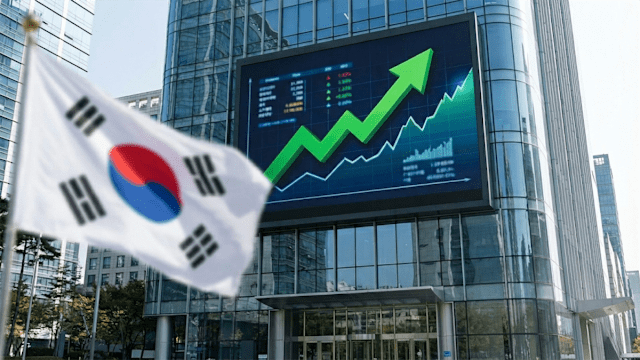


South Korea has firmly established itself as one of the world’s best-performing equity markets this year. In a historic bull run that has reshaped the Asian investment landscape, the benchmark KOSPI index recently breached the 8,100-point milestone, marking a staggering year-to-date accumulation that sits just shy of 90%.
The meteoric rise has caught global fund managers by surprise, pushing South Korea’s total market capitalization to roughly $4.28 trillion. The country has now overtaken several traditional European financial hubs, including France, to become the world’s eighth-largest stock market.
The Dual Engines of the Korean Rally
Market analysts point to a “perfect storm” of monumental semiconductor profits and aggressive legislative regulatory overrides as the primary drivers behind the unprecedented surge.
1. The AI Memory Chip Supercycle
At the absolute core of the KOSPI’s performance is South Korea’s near-monopoly on the hardware infrastructure essential to the global artificial intelligence boom. Hyperscale cloud providers and AI data centers have driven an unprecedented supply shortfall for High-Bandwidth Memory (HBM) chips.
Because semiconductor manufacturing carries intense operating leverage, skyrocketing spot prices have translated directly into outsized bottom-line corporate growth:
- Samsung Electronics: Gained over 80% year-to-date, with its valuation briefly crossing the $1 trillion threshold.
- SK Hynix: Surged dramatically to trade above 2,000,000 KRW, logging multi-hundred percent gains over a rolling 12-month window.
Goldman Sachs Research recently highlighted that South Korean corporate earnings growth for the fiscal year is projected to hit 300%—the sharpest annual profit expansion observed in any Asian market since the 1999 recovery from the Asian Financial Crisis.
2. Dismantling the “Korea Discount”
Historically, South Korean equities traded at a discount compared to global peers due to opaque conglomerate governance structures (chaebols) and famously low dividend payouts. In 2026, the South Korean government systematically dismantled this “Korea Discount” via aggressive fiscal policies:
- Tax Code Overhauls: Top-tier dividend income tax rates were slashed from a restrictive 45% down to a tiered 14%–30% structure, incentivizing massive cash payouts to shareholders.
- Regulatory Compliance Pressure: The Korea Exchange enacted strict enforcement policies, publicly identifying companies sitting in the bottom 20% of price-to-book (P/B) ratios within their respective sectors for consecutive terms, forcing corporate boards to initiate heavy stock buyback programs.
A Deepening Structural Imbalance?
Despite the euphoric top-line numbers, institutional analysts are warning of severe concentration risks baked into the current index structure.
Following the massive valuation expansion of the chip sector, Samsung Electronics and SK Hynix now collectively command over 47% of the entire KOSPI index weight. Data indicates that if these two semiconductor juggernauts are excluded from the calculation, the year-to-date gains for the remaining hundreds of listed companies narrow significantly to roughly 30%.
Outlook and Valuations
While short-term retail margin balances are heavily crowded—leaving the market susceptible to sudden technical corrections or forced liquidations if a 10% pullback occurs—medium-term fundamentals remain exceptionally strong.
Unlike historic speculative tech bubbles, the 2026 Korean rally is entirely backed by realized corporate cash flows and multi-year supply contracts. Even at record index highs, the KOSPI continues to trade at single-digit forward price-to-earnings (P/E) multiples, prompting major global brokerages like Goldman Sachs and Nomura to raise their 12-month baseline KOSPI targets to 9,000 points.