

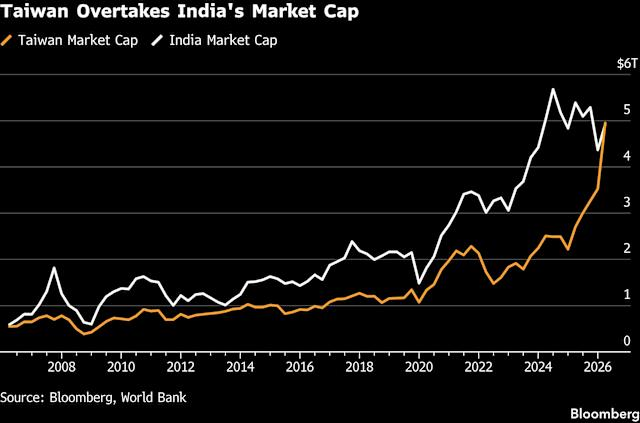
In a tectonic reallocation of global capital, Taiwan’s stock market has officially eclipsed India’s to claim the title of the fifth-largest equity market in the world. According to data compiled by Bloomberg, the aggregate market capitalization of Taiwan’s equity universe surged to $4.95 trillion, edging past India’s total market value, which recently adjusted downward to $4.92 trillion.
With this milestone, Taiwan now sits in elite company on the global leaderboard, trailing only the equity markets of the United States, mainland China, Japan, and Hong Kong.
The flip in rankings highlights a massive structural divergence in how international investors are deploying capital. While India’s sprawling, domestic-led economic engine grapples with short-term headwinds, Taiwan has ridden an unprecedented wave of global enthusiasm for hardware linked to artificial intelligence (AI).
The TSMC Factor: High Concentration, High Reward
The primary catalyst for Taiwan’s rapid ascent up the global equity ladder can be summarized in four letters: TSMC. The Taiwan Semiconductor Manufacturing Company—the world’s undisputed king of advanced foundry services and chip fabrication—has seen its shares surge by a staggering 49% since the beginning of the year.
Because TSMC forms the absolute foundation of the global AI supply chain, fabrication orders from global tech giants have pushed its valuation to historic highs. This immense growth has introduced a unique dynamic to Taiwan’s equity environment. TSMC now single-handedly commands more than 42% of the benchmark Taiwan Weighted Index, representing a massive concentration of market weight.
The upward trajectory was further accelerated by recent domestic regulatory interventions. Taiwan’s Financial Supervisory Commission recently raised the legal ceiling governing how much domestic mutual funds can allocate to a single equity asset. Analysts at JPMorgan Chase & Co. estimate that this regulatory relaxation could single-handedly unlock more than $6 billion in fresh domestic capital inflows, with TSMC standing as the primary eligible beneficiary.
Why India’s Equity Market Faced Pressure
While Taiwan’s tech-heavy index routinely breaches all-time highs—with the Taiwan Weighted Index breaking past the 44,000-point milestone—India’s equity markets have encountered a period of consolidation and cooling.
Several macroeconomic factors have triggered this relative slowdown:
- Rising Energy Costs: Heightened geopolitical conflicts have driven global crude oil prices upward. As a heavy net importer of energy, India’s broader corporate margins are highly sensitive to fluctuating oil dynamics, dampening near-term earnings growth expectations.
- Foreign Capital Outflows: International institutional funds have executed a major regional rotation. Foreign investors have pulled nearly $24 billion out of Indian equities, redirecting those assets toward markets heavily weighted in cutting-edge tech hardware, like Taiwan and South Korea.
- High Relative Valuations: Prior to the correction, Indian benchmark indices were trading at premium valuation multiples compared to historical averages, triggering natural profit-taking from institutional desks.
Two Divergent Economic Models
Financial analysts emphasize that this shift in stock market value does not mean Taiwan’s economy is larger than India’s. Rather, it reflects how different economic structures monetize global investment trends.
India remains an economic powerhouse with a gross domestic product (GDP) hovering at approximately $4.15 trillion, supported by a massive consumer base, banking sector stability, and diverse services. Taiwan, by comparison, operates with a much smaller domestic GDP of around $977 billion but boasts an ultra-dense, tech-export-driven capital market.
As financial asset managers look toward the future, the flip in the global index ranking underscores a broader theme. In the current global investment cycle, traditional brick-and-mortar sectors and localized consumption stories are temporarily being overshadowed by pure-play tech hardware. For now, the global investing community is heavily prioritizing chip fact