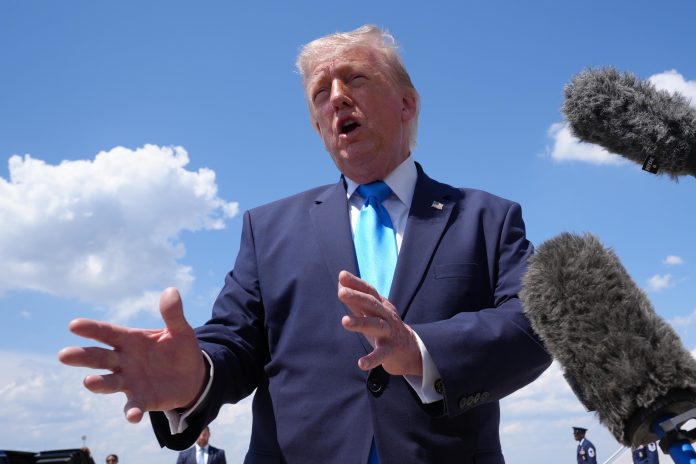


In a major diplomatic update following a turbulent weekend of military flare-ups, U.S. President Donald Trump announced that negotiations with Iran have reached their absolute final stages. Speaking to reporters on Tuesday morning upon his return from an NBA Finals game, Trump stated that the administration is in the “final throes” of securing a comprehensive West Asia peace agreement.
When pressed on a definitive timeline, Trump confidently remarked that a breakthrough would be a matter of “two or three days”.
Navigating a High-Stakes Weekend Flare-Up
The President’s optimistic timeline comes immediately after intense backdoor diplomacy successfully contained a severe military escalation that threatened to derail months of delicate, Pakistan-mediated negotiations.
   [Sunday, June 7]                          [Sunday Night]                       [Monday, June 8]
Israel launches strikes ──► Iran retaliates with ballistic ──► Israel retaliates with ──► Both sides declare
   on Beirut, Lebanon           missiles targeting Israel          airstrikes on Iran        hostilities "halted"
- The Trigger: On Sunday, June 7, Israel launched airstrikes on Beirut, Lebanon, bypassing Trump’s public warnings against targeting the capital.
- The Retaliation: In response, Iran fired a barrage of ballistic missiles directly at Israel for the first time since the initial April ceasefire.
- The Containment: Following a flurry of emergency phone calls—including reports that Trump directly pressured Israeli Prime Minister Benjamin Netanyahu to stand down to preserve the peace deal—both Israel and Iran announced on June 8 that hostilities had been successfully contained and halted.
Core Pillars of the Emerging Deal
While Iranian Foreign Ministry officials caution that the agreement “has not been finalized yet,” the structural framework heavily pushed by U.S. and Pakistani mediators centers on three non-negotiable points:
1. Reopening the Strait of Hormuz
A cornerstone of the U.S. framework requires Iran to completely reopen the Strait of Hormuz to international shipping and clear out all maritime mines. Iran closed the strategic shipping lane during the initial outbreak of the war, heavily bottlenecking global energy trade.
2. Concrete Nuclear Commitments
Trump has doubled down on strict nuclear parameters, publicly posting on social media that “Iran must agree that they will never have a Nuclear Weapon or Bomb” as a prerequisite for any permanent U.S. sanctions relief or the release of billions in frozen Iranian assets.
3. The Lebanon Contingency
A major remaining hurdle is the scope of the truce. Backed by Lebanese armed forces currently holding parallel talks in Islamabad, Tehran is heavily conditioning the peace deal on a synchronized ceasefire between Israel and the Iran-backed Hezbollah militant group in Lebanon.
Lingering Distrust and Skepticism
Despite Trump’s insistence that a historic deal is just days away, a thick layer of skepticism remains among military leaders in Tehran.
Iranian Parliament Speaker Mohammad Bagher Qalibaf openly pushed back against premature American celebrations, warning that Iran places “no trust in guarantees or words” and will only judge the deal based on concrete U.S. and Israeli actions. Furthermore, state media outlets close to the Islamic Revolutionary Guard Corps (IRGC) have signaled that control over the Strait of Hormuz remains a massive red line, suggesting that Trump’s rapid 2-to-3-day window may be an overly optimistic prediction designed for political messaging.