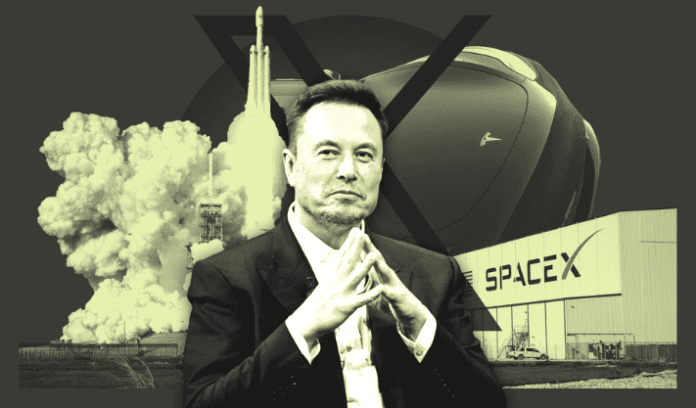


Following the publication of its landmark S-1 registration statement ahead of its historic public market debut under the ticker SPCX, SpaceX has officially disclosed its full-year financials. The company reported a total consolidated revenue of $18.7 billion for full-year 2025.
While the top-line represents a robust 33% year-over-year increase from the $14.1 billion recorded in 2024, the filing reveals a highly complex, capital-heavy operation that is aggressively absorbing the costs of Elon Musk’s broader artificial intelligence ambitions.
The Growth vs. Profit Dichotomy
SpaceX’s core space and satellite operations are highly profitable on an operational baseline, but massive infrastructure investments have kept the consolidated company net-negative on paper.
- Adjusted EBITDA Profit: On an adjusted basis, SpaceX recorded a strong $6.6 billion in EBITDA profit for 2025, heavily driven by Starlink’s scaling subscriber base and surging high-speed internet margins.
- GAAP Net Loss: Despite the positive EBITDA, the company posted a consolidated GAAP net loss of $4.94 billion for 2025. The gap is primarily driven by heavy stock-based compensation, depreciation on the Starlink constellation, and massive AI capital expenditures.
- The AI Cash Burn: The core culprit dragging the company into the red is its artificial intelligence segment, following its formal absorption of xAI. The S-1 reveals that SpaceX’s AI operations posted an operating loss exceeding $6 billion in 2025 alone.
2026 Acceleration: Deepening Losses in Q1
If 2025 highlighted heavy spending, the first quarter of 2026 shows a business moving into overdrive to build out AI data centers.
In Q1 2026, SpaceX posted a net loss of $4.3 billion on just $4.7 billion in revenue. Out of the $10.1 billion in total capital expenditures logged during those three months, a staggering $7.72 billion was attributed exclusively to artificial intelligence infrastructure—meaning Starlink’s success is effectively subsidizing an intense computing buildout.
The Trillion-Dollar Valuation Debate
At the targeted IPO price of $135 per share, SpaceX is seeking a debut market capitalization of $1.75 trillion. This valuation architecture sets up a unique math equation for Wall Street analysts:
| Parameter | 2025 Metric Baseline | Implied IPO Multiple |
| Consolidated Revenue | $18.7 Billion | ~94x Trailing Sales |
| Adjusted EBITDA | $6.6 Billion | ~265x Trailing EBITDA |
| GAAP Net Income | ($4.94 Billion) | N/A (Loss-Making) |
An entry multiple of 94x trailing revenue is entirely without precedent for a company debuting at a trillion-dollar scale. For context, SpaceX currently generates less than a tenth of the revenue of tech giants like Apple or Alphabet, yet it enters the public market valued higher than Meta.
The Underwriting Case: Selling 2040 Today
Institutional underwriters led by Morgan Stanley are telling investors to view SPCX not as a traditional rocket manufacturer, but as an exponential AI and data distribution engine. The roadshow case assumes that SpaceX’s AI business—which brought in just $3.2 billion in 2025—will leap to anywhere between $190 billion and $322 billion by 2030 as autonomous systems and compute grids scale up.
To justify its $1.75 trillion sticker price today, investors must fundamentally buy into a long-duration venture thesis that assumes SpaceX can compound its consolidated revenue at roughly 41% annually for the next 15 years to reach $3.4 trillion by 2040.