


At the Augmented World Expo (AWE) 2026, Snap CEO Evan Spiegel officially unveiled Specs—the company’s first standalone, fully wireless consumer augmented reality (AR) glasses.
Priced at $2,195, the hardware represents a massive leap forward from the company’s older, tethered developer kits. Pre-orders are live with a $200 refundable deposit, and the units are scheduled to ship this fall across the U.S., UK, and France.
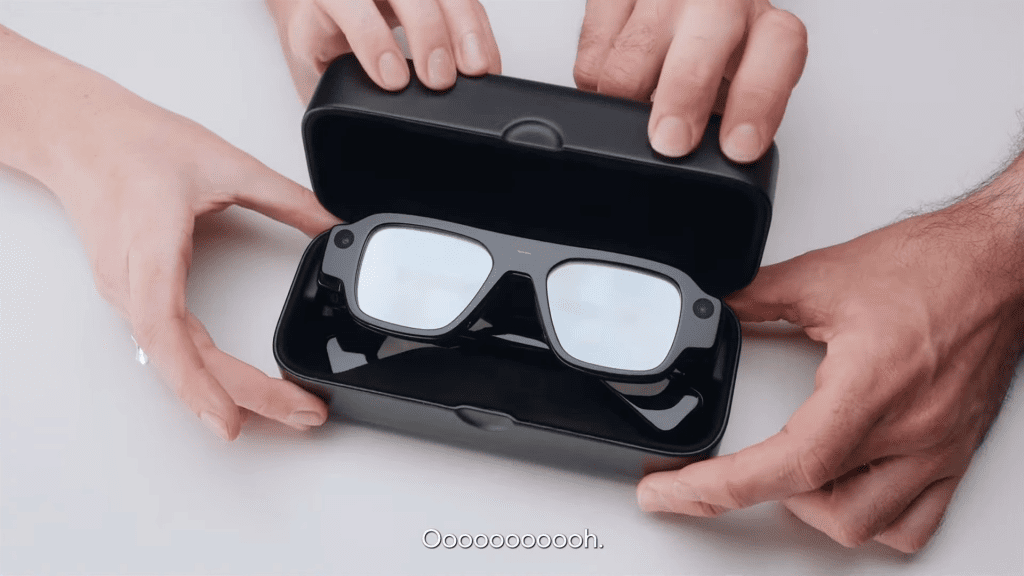
Hardware Architecture: True Standalone AR
The defining characteristic of the new Specs is their completely untethered design. Unlike competing products from companies like Xreal or RayNeo, which require a physical USB-C cable running to a phone or a pocket-sized computing “puck,” all processing and battery systems are integrated directly into the frame.
- Dual-Processor Engine: The glasses are driven by two separate Qualcomm Snapdragon chips. One processor is dedicated exclusively to computer vision tasks (such as head-position tracking, environment meshing, and spatial anchoring), while the second chip handles the operating system, hand tracking, and active display execution.
- Low-Latency Tracking: By separating these computing pipelines, Snap has achieved a motion-to-photon latency of just 7 milliseconds—a metric that notably outperforms the Apple Vision Pro’s 12-millisecond baseline for gesture and environment synchronization.
- Materials and Weight: The frame is built using high-performance Swiss TR90 polymer to maximize flexibility and toughness. It comes in two sizes: a 47mm model weighing 132 grams and a 52mm model weighing 136 grams.
Display Metrics: Floating Desktop and Cinema Views
The visual engine transitions away from simple text overlays to deliver true spatial computing environments:
| Key Hardware Metric | Realized Specification | Equivalent Consumer Experience |
| Display Technology | Liquid Crystal on Silicon (LCoS) | Renders a color depth of 16 million colors |
| Field of View (FoV) | 51-degree diagonal array | A 24-inch desktop monitor for work, or a 115-inch cinema screen at 10 feet |
| Lens Technology | Electrochromic adaptive lenses | Transition from completely clear to deeply tinted in 10 seconds |
The electrochromic lenses solve a major real-world hurdle for smart glasses: they adjust rapidly to shifting light conditions, ensuring that digital objects remain visible when a user walks from a dark room into bright sunlight.
Power, UX, and the Developer Playbook
Because the glasses operate without external tethers, battery life remains the primary trade-off. Specs provide up to 4 hours of mixed-use battery life per charge, covering audio and video playback, spatial apps, and AI interactions. The included storage and charging case provides four additional full cycles, extending total on-the-go usage to 20 hours.
For out-of-the-box utility, Snap is shipping the device with a suite of native apps for web browsing, multi-screen laptop extensions, real-world translation, and a vision-enabled contextual AI assistant.
Crucially, the launch marks a strategic attempt by Snap to lock in market share before Meta rolls out its own rumored consumer-ready AR glasses. To capture developer momentum, Snap has launched a native software development kit (SDK) inside Lens Studio, while rolling out dedicated developer preview extensions across major automated programming hubs like Claude Code and Cursor.