

Perplexity has officially launched Search as Code (SaC), a paradigm shift in how artificial intelligence models interact with the web. Moving away from the traditional, rigid paradigm where an AI must call a fixed search API and passively consume a static list of ranked results, SaC treats Perplexity’s massive web index as a programmable playground.
Instead of waiting on slow, sequential tool-calling loops, AI agents can now write and execute their own Python code to construct entirely custom search pipelines on the fly.
The Core Problem with Monolithic Search
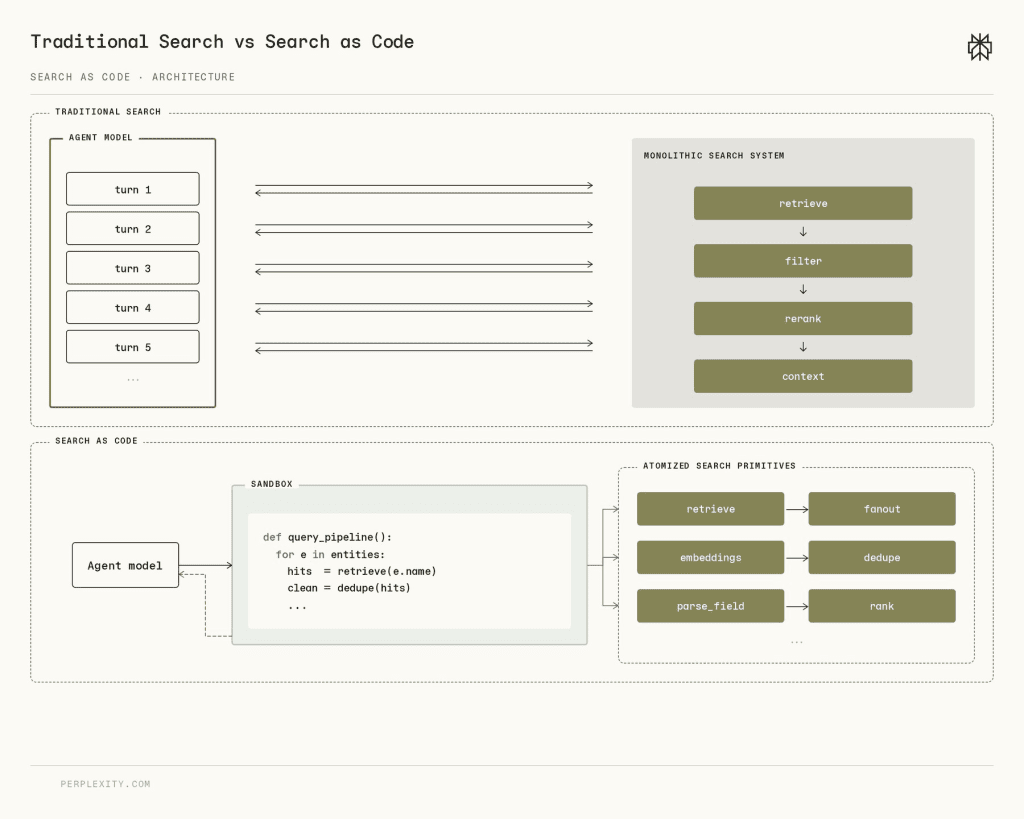
Historically, search integrations have treated the search engine like an external black box. For basic consumer queries, a one-shot “query in, results out” architecture works perfectly. However, this framework breaks down when an AI agent is tasked with highly complex, enterprise-grade research—such as identifying a hundred high-severity security vulnerabilities across a massive infrastructure stack.
Under legacy architectures, such an execution forces the AI through hundreds of sequential round trips. The model fires a query, reads noisy data, adjusts its query, and fires again. This creates three severe structural bottlenecks:
- Context Pollution: Gigabytes of noisy, intermediate web data pile into the model’s context window, degrading its reasoning capabilities.
- Inefficient Control Flow: The work is naturally parallel, but the model is forced to execute it serially, drastically inflating latency.
- Rigid Execution: If a model realizes midway through that it needs to blend semantic and lexical signals differently or prioritize a highly specific subset of domains, a rigid API prevents it from adjusting its strategy.
How Search as Code Re-engineers Retrieval
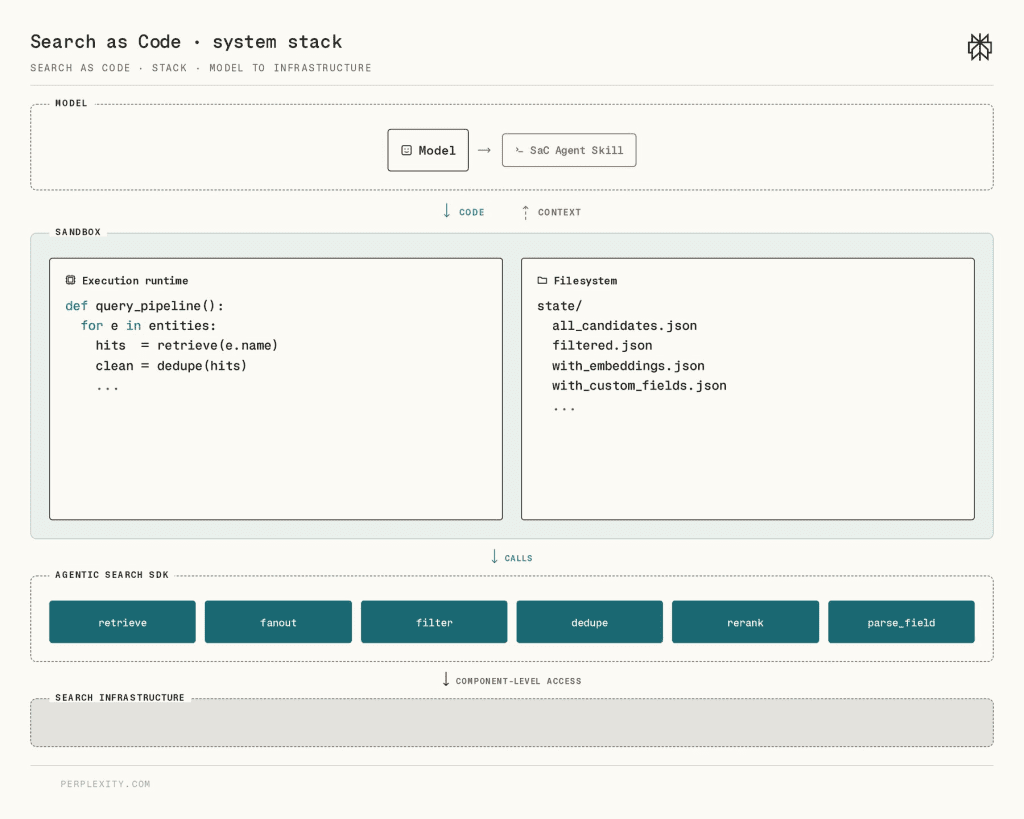
Search as Code handles this by disassembling the components of Perplexity’s search stack into atomic primitives. The model composes these primitives directly into an executable Python script tailored precisely to the task at hand.
The architecture functions across a tightly integrated three-layer ecosystem:
- Models as the Control Plane: The AI handles the high-level strategy, breaking down the user’s broad directive into sub-tasks and generating the specific retrieval code required.
- Compute Sandboxes as the Runtime: The generated Python script is run inside a secure, deterministic compute environment.
- The Agentic Search SDK as the I/O Layer: The SDK exposes low-level search commands as open building blocks.
Armed with this SDK, the model gains granular, direct control over Retrieval (what and where to fetch), Fan-outs (branching multiple concurrent searches across an index of 200 billion URLs), Ranking & Filtering (what metrics to score and what to discard), Deduplication, and Verification (cross-checking findings before presentation).
The Efficiency Gains: Performance Metrics
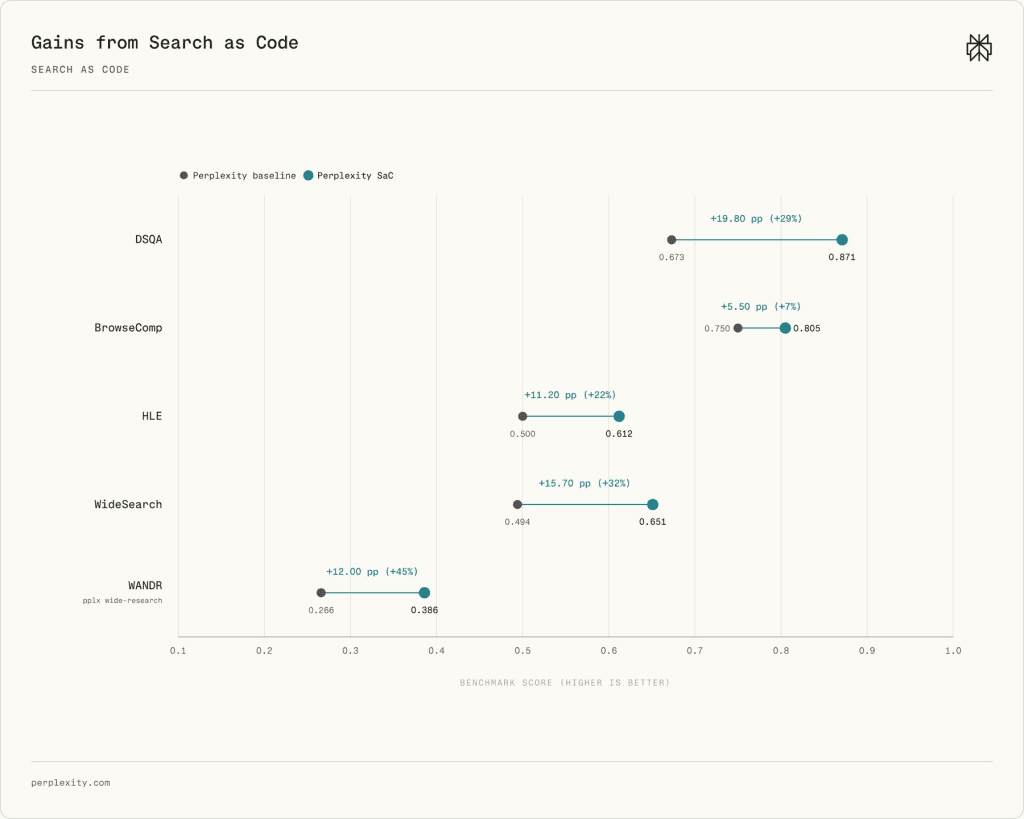
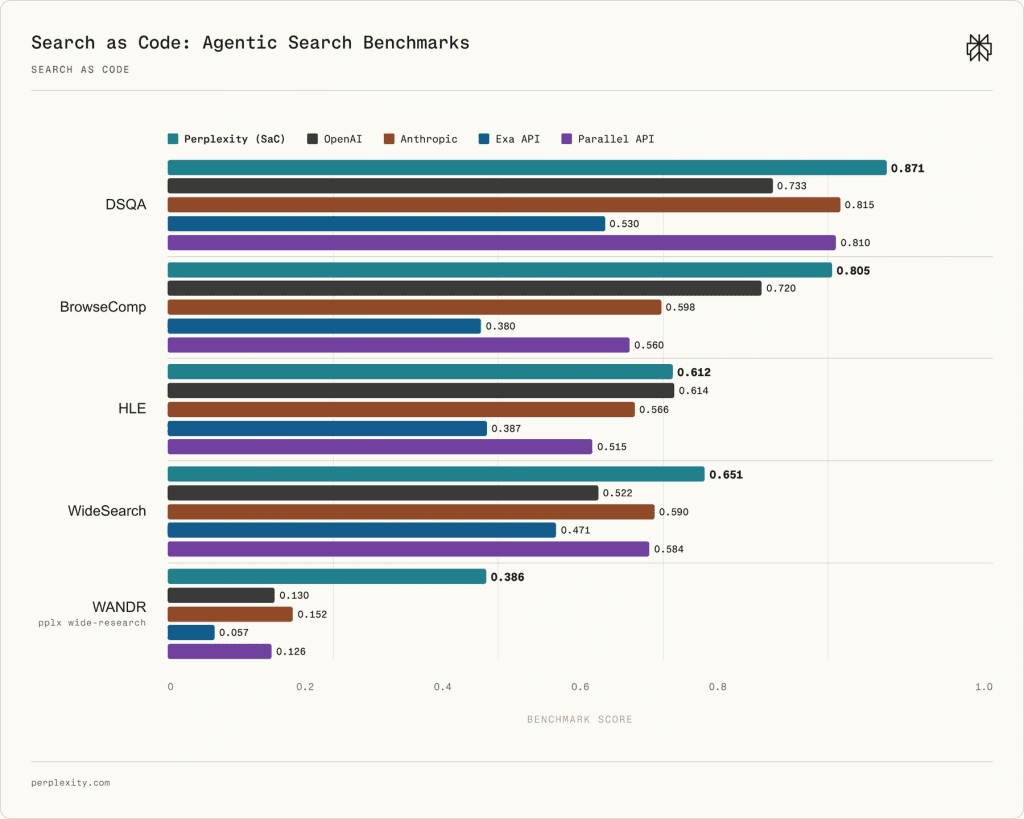
By condensing what used to be hundreds of independent model turns into a single, highly structured program execution, the architectural shift delivers major efficiency improvements:
| Benchmark Task Layer | Legacy Tool-Calling Flow | New Search as Code Performance | Impact Metric |
| Complex Vulnerability Advisory | Under 25% Accuracy across top models. | 100% Perfect Accuracy achieved. | Massive Reliability Boost. |
| Token Consumption Rate | High, compounding context overhead. | Slashed token usage by ~85%. | Direct Operational Cost Savings. |
| WANDR Benchmark Evaluation | Standard serial speed baseline. | Up to 2.5x faster overall execution. | Drastic Latency Reduction. |
Because filtering, sorting, and data joining happen deterministically within the execution sandbox, the model only reads the exact, distilled answer string it requires—keeping the context window clean and free of unnecessary noise.
Where to Access Search as Code
The SaC framework is no longer a localized research experiment; Perplexity has pushed it directly into production infrastructure:
- Perplexity Agent API: Enterprise developers can utilize this programmable infrastructure pattern to build custom search capabilities natively inside their own software scaffolds.
- Perplexity Computer: The architecture is now the live, out-of-the-box default operating mechanism for Perplexity Computer. The OS-like platform leverages SaC natively to automatically spawn sub-agents, handle background parallel research loops, and synthesize massive amounts of web data without human intervention.
For a deeper dive into the fundamental engineering thesis behind this release, you can review Rethinking Search as Code Generation, published directly by the Perplexity Research team. This resource explores how training models to become fluent in their own search SDKs completely replaces the limitations of legacy, black-box data endpoints.