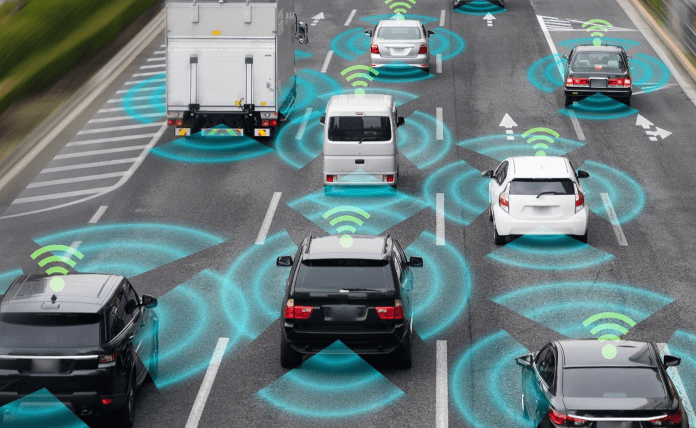


India’s major telecommunications giants—Reliance Jio, Bharti Airtel, and Vodafone Idea—have united to strongly oppose the creation of a separate, independent network for Vehicle-to-Vehicle (V2V) and Vehicle-to-Everything (V2X) communication.
The dispute centers around a highly valuable 50 MHz slice of radio spectrum in the 5.9 GHz band (5875–5925 MHz).
While the Ministry of Road Transport and Highways, led by Nitin Gadkari, announced plans to roll out mandatory V2V technology nationwide by the end of 2026 to slash highway accidents, a fierce policy battle has erupted over how that data should be transmitted. Automotive bodies, tech firms, and public safety advocates are pushing for the spectrum to be handed out for free as a shared, open network. The telecom operators, however, want the entire system routed through their own licensed commercial 4G and 5G networks.
1. The Telcos’ Case: “Don’t Bypass Our Multi-Billion Dollar 5G Networks”
Through submissions filed with the Telecom Regulatory Authority of India (TRAI) via the Cellular Operators Association of India (COAI), the telecom majors argue that building a dedicated, standalone short-range wireless network is an expensive, unnecessary duplication of existing national infrastructure.
- The Licensed Route Advantage: Telcos argue that routing V2V and V2X applications through Cellular V2X (C-V2X) protocol on their pre-existing 4G and 5G networks ensures a far more secure, robust, and scalable ecosystem. They claim their networks can provide long-range communication (e.g., warning a car miles away about a highway pileup), whereas standalone short-range radio signals are limited to roughly 300 meters.
- The Auction Challenge: Reliance Jio has taken the most aggressive stance, explicitly challenging the legal mechanism for free allocation. In its formal letter to TRAI, Jio argued that V2V communication does not qualify as an exempted “transport safety service” under the Telecommunications Act, 2023. Because private car manufacturers and tech firms will package and sell these connected car features commercially, Jio insists the spectrum must be allocated strictly via a competitive public auction.
- Financial Stakes: The revenue at stake is massive. Members of the Wireless Planning Commission (WPC) estimate the economic value of the 50 MHz V2X band at approximately ₹900 crore ($108 million) per annum based on recent 5G auction reserve benchmarks—money the government would forfeit if the band is given away for free.
2. The Auto & Tech Counter-Argument: A Safety System, Not a Commercial Product
On the other side of the aisle, the 5G Automotive Association (5GAA) and the Broadband India Forum (BIF) are fiercely lobbying the Department of Telecommunications (DoT) to stick to the open-allocation model originally outlined in the National Frequency Allocation Plan (NFAP-2025).
Safety experts argue that making V2V dependent on telecom operators introduces a dangerous commercial barrier. If telcos control the network, they will inevitably pass licensing costs, spectrum usage charges (SUC), or premium connectivity fees onto car manufacturers and vehicle owners. They argue that an open, shared 5.9 GHz band—operating similarly to how public Wi-Fi functions—is the only way to ensure that every vehicle, from a budget hatchback to a multi-axle commercial truck, can instantly communicate without a telecom subscription wall.
3. The On-Board Unit (OBU) Bottleneck
As TRAI sifts through these conflicting corporate interests, automotive manufacturers are eyeing the impending end-of-2026 mandate with growing logistical concern.
To make a separate V2V network function, every new vehicle must be physically fitted with an On-Board Unit (OBU)—a localized transceiver that continuously broadcasts speed, position, direction, and braking status.
Apparel and component engineering teams estimate that these OBUs will add an immediate cost of ₹5,000 to ₹7,000 per vehicle. In a highly price-sensitive automobile market like India, manufacturers warn that mandating this hardware before settling the underlying spectrum war could trigger severe supply chain friction, especially if retrofitting older heavy commercial vehicles is made compulsory down the line.