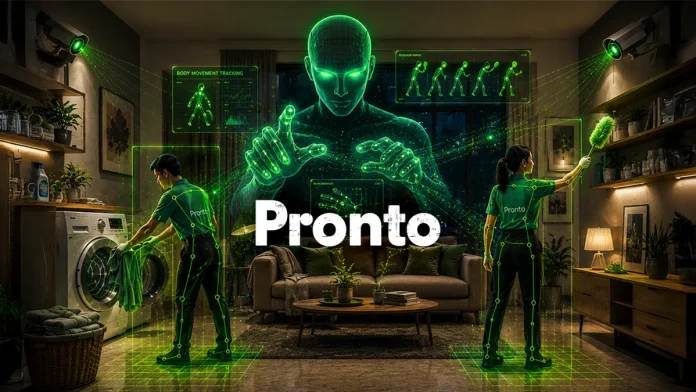


India’s instant home-services race has taken a highly unexpected, futuristic pivot. Pronto, the fast-growing on-demand household help startup founded by Anjali Sardana, is quietly positioning its gig workforce to double as a real-world data infrastructure layer to train global Physical AI and humanoid robotics models.
According to internal investor documents from its recent $45 million Series B round led by Lachy Groom, the startup’s backend strategy stretches far beyond a typical consumer service play. A memo from investor Glade Brook Capital explicitly reveals that “Pronto is seeking to formalize India’s vast informal labor markets and in the process generate data to help train physical AI and robotics.”
1. The Operational Blueprint: Capturing Household Workflows
To bridge the massive data gap between virtual simulations and the chaotic reality of physical environments, Pronto is transforming everyday chores into data-gathering assignments.
- The Wearable Camera System: Pronto professionals carry compact, outward-facing body cameras or AR glasses during their shifts.
- The “First-Person” Dataset: As workers execute chores like washing dishes, loading appliances, organizing living rooms, folding laundry, or scrubbing utensils, the cameras capture high-fidelity, first-person visual feeds of precise human hand movements and real-world spatial navigation.
- Opt-In & Security Guarantees: Pronto frames the recordings primarily as a transparent quality assurance tool, noting that customers must explicitly choose to opt-in to have a job recorded and that they receive a copy of the footage afterward. The company claims that consumer video data is strictly deleted within 48 hours and remains completely inaccessible to third parties.
2. The Global Race for “Physical AI” Data
The disclosure illuminates why international venture capital is aggressively flooding into localized gig platforms. While Generative AI is built on scraped internet text and images, embodied intelligence (robotics) requires thousands of hours of real-world behavioral training to understand delicate, contact-rich tasks.
| Company / Platform | Distributed Workforce Initiative | Core Data Objective |
| Pronto (India) | 6,500+ home service professionals processing 25,000+ daily orders. | Mapping domestic workflows (cooking, cleaning, folding) to build foundational data layers for consumer household robots. |
| DoorDash (US) | Launched “Tasks”, a dedicated app for its 2 million delivery couriers. | Filming specific manual assignments (e.g., handwashing 5 dishes sequentially) to train commercial humanoid manipulators. |
| Micro1 / Objectways | Scaling specialized “hand movement farms” across India and South America. | Meticulously filming workers using GoPros to pack boxes, handle fabrics, and sort utensils for heavy industrial automation. |
3. Monetization Synergy vs. The Compliance Question
Pronto is addressing the shift by pitching it as an elite economic upside for its worker base. The startup notes that by compiling these specialized datasets, its professionals can actively participate in the high-margin AI economy, earning direct data-generation bonuses that push average monthly gig earnings to ₹35,000–₹55,000, well above the informal industry average.
However, the strategy is drawing intense scrutiny from data privacy and legal experts. Technologists point out a massive regulatory contradiction: while Pronto assures customers that household footage is permanently wiped within 48 hours for local safety, its main venture backers are simultaneously valuing the firm at $200 million based on its long-term ability to pilot and license these exact real-world training datasets to overseas physical AI laboratories. Analysts warn that compiling video feeds from inside private Indian residences to train autonomous systems could run into severe compliance bottlenecks under the purpose-limitation clauses of India’s Digital Personal Data Protection (DPDP) Act.