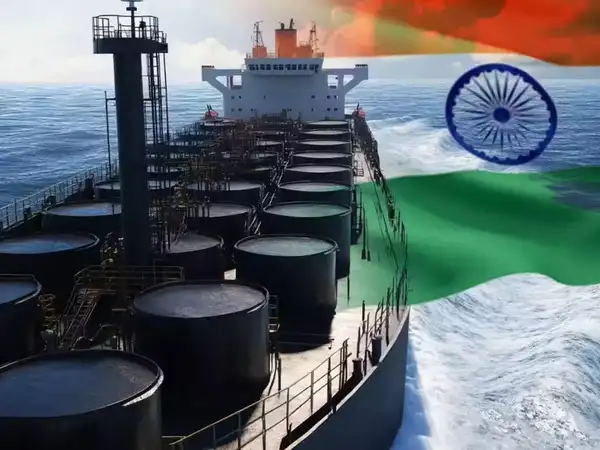


A staggering paradox has hit India’s macroeconomy. Driven by severe supply chain friction from the West Asia conflict and the blockading of the Strait of Hormuz, India’s crude oil import bill surged 52.3% year-on-year to $16.3 billion in April 2026—even as the physical volume of crude imported actually fell by 4.3%.
Provisional data compiled by the Ministry of Petroleum’s Petroleum Planning and Analysis Cell (PPAC) highlights the extreme financial pressure commodity inflation is exerting on India’s balance of payments. In April last year, India purchased a higher volume of 21 million metric tonnes (MMT) of crude for a modest $10.7 billion. This April, buying a leaner 20.1 MMT cost the nation a painful $5.6 billion more.
1. The Core Variable: The Indian Crude Basket Explosion
The primary driver behind this ballooning capital drain is the vertical spike in global benchmarks. While India has systematically diversified its sourcing—with Bharat Petroleum and Indian Oil aggressively bumping Russian Urals crude to a record 41% share of total imports—the broader market pricing matrix remains highly volatile.
[Average Cost of the Indian Crude Basket]

April 2025:  $67.72 per barrel
             ██████████████
April 2026:  $114.48 per barrel (+69%)
             ████████████████████████
While international crude prices surged nearly 70% over the 12-month window, the absolute value of the import bill rose at a slightly lower 52% clip because domestic refiners successfully curtailed processing volumes to absorb the shock.
2. Slicing Open the Broader Energy Ledger
The energy strain was felt heavily across all major fossil fuels and utilities. High international landing costs forced a sharp reduction in domestic consumption, altering the country’s dependence on imported natural gas and petroleum products:
| Energy Commodity | April Volume Shift (YoY) | Value Performance & Policy Interventions |
| Liquefied Natural Gas (LNG) | Dropped 29.6% to 1,954 MMSCM | Lower industrial demand allowed the LNG import bill to slide one-fourth, down from $1.2 billion to $0.9 billion, dropping India’s gas import dependency to 41.6%. |
| Liquefied Petroleum Gas (LPG) | Contracted 12.7% to 2.2 MMT | Driven by Middle East supply curbs, the government rationed commercial establishments to 70% of pre-crisis supply levels and extended domestic refill booking periods to protect households. |
| Refinery Output Optimization | Expanded 30% on domestic LPG | Indian refiners shifted internal processing metrics, ramping local LPG production up to 1.3 MMT to offset missing West Asian gas shipments. |
3. The Structural Trade Deficit and Rupee Pressure
The massive expansion of the gross energy bill, combined with an 82% monthly spike in gold imports, caused India’s overall merchandise trade deficit to widen to a six-month high of $28.38 billion for the month of April.
The Cushion Effect: The macro damage was partially mitigated by a parallel 34% surge in India’s refined petroleum exports, which clocked $18.6 billion as global fuel shortages boosted refining margins. Consequently, the country’s net oil import bill (gross imports minus refined exports) was successfully contained at a manageable $9 billion.
4. Direct Interventions by Policymakers
The extreme foreign exchange outflow has prompted unprecedented coordination between the government and the Reserve Bank of India to shield the economy from a 1991-style balance of payments shock:
- Customs Duty Intervention: The Ministry of Finance implemented aggressive duty hikes on gold, silver, and platinum to intentionally choke non-essential import volumes and conserve valuable dollar reserves.
- The Prime Minister’s Appeal: Prime Minister Narendra Modi issued a rare public appeal urging citizens and corporations to actively conserve fuel, adopt flexible remote work policies where applicable, and utilize public transport networks to structurally suppress nationwide energy demand.
- The OMC Shock Absorber: To protect the fiscal balance sheet from a projected ₹1 lakh crore quarterly refining loss, the government cleared a series of staggered retail price corrections, including the recent 87-to-91 paise per litre hike in petrol and diesel rates to gradually bring oil marketing companies back to operational break-even points.