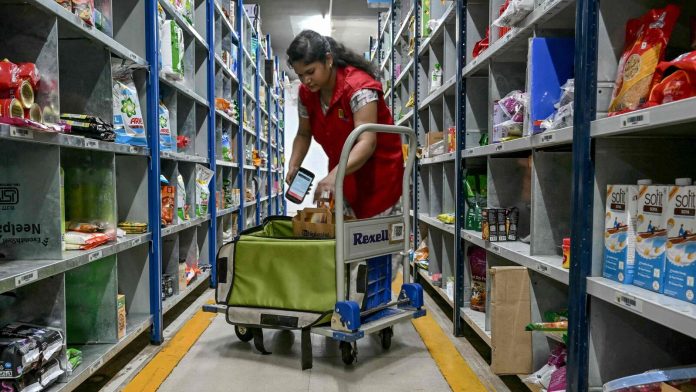

The Ministry of Finance and state governments have entered active discussions to significantly ease Goods and Services Tax (GST) registration norms for quick-commerce “dark stores.”
The initiative aims to eliminate a massive structural bottleneck for hyper-local delivery platforms like Blinkit, Zepto, Swiggy Instamart, and Tata BigBasket, freeing up trapped working capital and accelerating retail expansion.
1. The Bottleneck: The “Additional Place of Business” Trap
Under current rules, quick-commerce players face severe compliance friction when expanding their network of neighborhood fulfillment hubs.
- The Address Proof Hurdle: To sell goods legally from a micro-warehouse, platforms or their onboarded vendor partners must register each dark store as an “Additional Place of Business” (APOB) under their primary GST registration.
- The Documentation Gap: This process strictly requires formal address proof, such as an individual rental agreement or a dedicated electricity bill. However, because quick-commerce giants typically lease massive hub properties and sublet spaces or aggregate multiple third-party merchant inventories under one roof, individual vendors rarely hold standalone rent agreements.
- The Fraud-Prevention Clash: This structural gap directly clashed with recent efforts by the Central Board of Indirect Taxes and Customs (CBIC) to aggressively tighten physical verification rules to eliminate fake input tax credit (ITC) invoicing networks. As a result, hundreds of legitimate dark store setups faced processing delays, freezing local inventory operations.
2. The Proposed Solution: Shared Virtual Moats
To resolve the infrastructure deadlock without diluting tax oversight, the government is framing a simplified compliance pipeline:
- Unified Infrastructure Documentation: The revised framework will allow e-commerce operators to provide a single, master lease agreement for a dark store property. Onboarded merchant partners can then use this master document alongside a digital “Consent Letter” from the platform to instantly clear the APOB address proof hurdle.
- Recognition as “Logistics Infrastructure”: Industry groups are actively lobbying to reclassify dark stores as physical logistics infrastructure rather than standard brick-and-mortar retail outlets. This shift would unlock more flexible urban zoning permissions, streamlined local licensing, and smoother inter-state transfer mechanics.
- Unlocking Trapped ITC: Quick-commerce finance leaders note that simplifying the dark store network configuration will streamline Input Tax Credit reconciliation, drastically reducing cash outflows spent resolving mismatched invoices.
3. The Quick-Commerce Boom
| Operational Metric | Current Segment Footprint |
| Network Density | Leading platforms now operate over 500 to 700+ dark stores each across major tier-1 and tier-2 cities. |
| Expansion Velocity | Top players are adding an average of 30 to 45 new micro-hubs per month to protect delivery timelines. |
| Delivery Framework | Purely digital fulfillment hubs closed to walk-in consumers, stocking 5,000 to 10,000 high-frequency inventory items. |
4. What’s Next?
The proposed relaxations are being fine-tuned by a dedicated committee of central and state tax officials. The finalized framework is expected to be placed on the agenda for an upcoming GST Council Meeting later this year for formal approval and nationwide implementation.